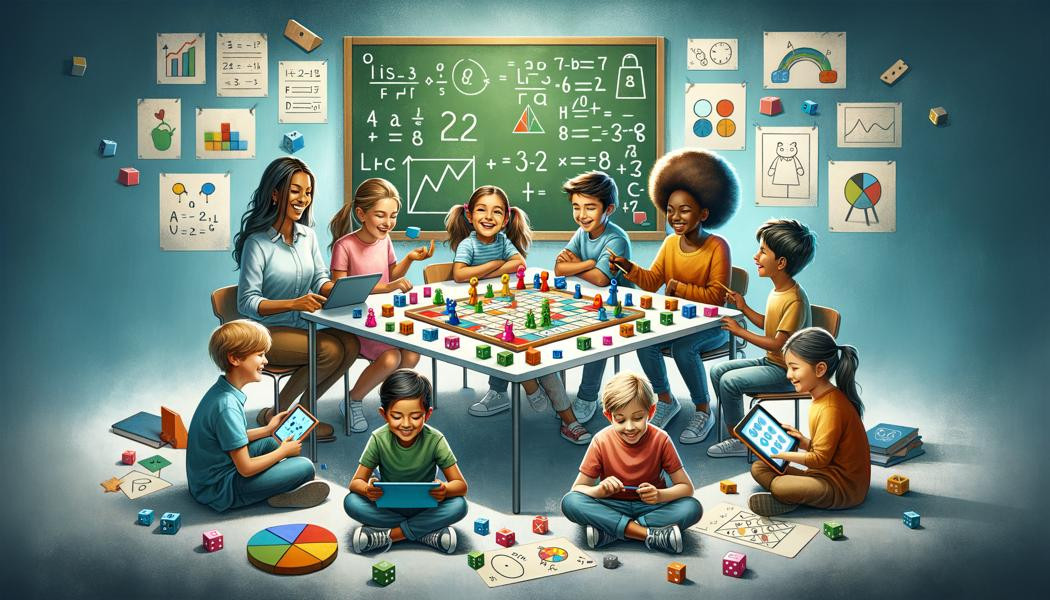
The title of this article, "Understanding Mathematics Through Play: Playful Tips 2025," underscores the importance of approaching the teaching of mathematics in a creative and engaging manner. In a world where traditional learning may sometimes seem dry for children, it is crucial to find methods that capture their attention and allow them to develop a keen interest in this fundamental subject. This article will cover several critical aspects of learning mathematics through play. We will examine why games are an effective method for teaching mathematics, the types of games that work best, how these games can spark children’s interest, the skills that children can acquire, as well as recommendations for suitable games. Additionally, we will look into the integration of video games in learning mathematics and tips for designing your own games. This playful journey into the world of mathematics promises to reveal accessible strategies for teaching and learning.
Do you need help understanding mathematics through play? Quickly find a qualified provider on Helplease and benefit from tailor-made service to meet all your needs. Discover professionals near you!Table of Contents
- Why use play to teach mathematics?
- What are the most effective types of games for learning mathematics?
- How can games stimulate children's interest in mathematics?
- What mathematical skills can be developed through play?
- Which board games do we recommend for strengthening mathematical knowledge?
- How can video games be integrated into mathematics learning?
- What playful tips make mathematics more accessible?
- How to design your own mathematics games at home?
- What are the advantages of group games for learning mathematics?
- How to evaluate children's progress through mathematical play?
- What feedback exists on the use of games to teach mathematics?
- How important is creativity in learning mathematics through play?
Why use play to teach mathematics?
Mathematics can sometimes be seen as a difficult or abstract subject. Using play to teach mathematics brings back the joy of learning by making concepts more accessible and concrete. By playing, children are more likely to engage actively in their learning, thus promoting knowledge retention. Games introduce elements of competition and cooperation that can enhance students' motivation and interest. Moreover, the playful context of games encourages exploration and experimentation, allowing children to discover mathematical concepts in a creative and stimulating way.
Furthermore, games can offer immediate feedback, which is crucial for helping children develop their skills. When playing, students can try different strategies, see their mistakes in real time, and adjust their approach without the pressure of a traditional classroom environment. This enables them to build their confidence and foster a positive attitude towards mathematics.
Games can also serve as a tool to assess children's mathematical skills. By observing a game, teachers and parents can identify strengths and areas for improvement, which allows them to tailor their teaching methods accordingly. This game-based approach enables the adoption of a more personalized and targeted learning process.
In short, teaching mathematics through play is not just an innovative method, but also an effective way to turn reluctant learners into enthusiastic students captivated by mathematics.
Professionals, looking for more clients? Register with Helplease today to offer your services and grow your business. Access a large customer base in just a few clicks!What are the most effective types of games for learning mathematics?
Games that concentrate on specific mathematical elements, such as arithmetic operations, geometry, or even logic, are especially effective for learning. Board games like "Monopoly" or "Math Dice" allow children to practice their addition and subtraction skills while providing a playful context. Card games, such as "Uno" or "Set," can also be used to teach calculation concepts and logical analysis.
At the same time, construction games like Lego encourage spatial visualization and geometric understanding. These hands-on activities allow children to handle objects, helping them develop a tactile understanding of mathematical concepts. You can also include online games that introduce mathematical problems in an interactive and engaging way. Platforms such as "Prodigy" or "Cool Math Games" offer a variety of exercises that stimulate both interest and learning.
It is also important to vary the types of games to address different learning styles. For example, collaborative games encourage teamwork, while competitive games can boost personal motivation. Incorporating a variety of games helps maintain children's interest while approaching mathematics from different perspectives.
Teachers and parents must therefore be attentive in adapting games to each child's skill level in order to challenge them without causing frustration. Activities should be balanced to ensure that all students have fun while learning.
How can games stimulate children's interest in mathematics?
Games arouse engagement because they transform the learning of mathematics into an active, participatory activity. Children are often more receptive to learning when it is presented as a challenge or enjoyable activity. By playing, children form positive connections with mathematics, which may inspire them to further explore the subject and want to learn new skills.
Moreover, games promote curiosity. A child who plays a mathematical game will no doubt encounter concepts such as fractions, probability calculations, or spatial relationships in a way that feels natural and instinctive. The elements of surprise and discovery inherent in games will strengthen this desire to learn.
Games also encourage peer discussion, enabling children to explain their thought processes and debate different mathematical strategies. This reinforces their understanding and helps build social skills while integrating mathematical ideas. By learning through play, children can develop cooperation skills, learning to work together to solve problems.
Finally, games can also serve as a form of reward. By including reward elements in the game, such as points or levels to reach, you can encourage children to invest more. This motivates them to work to progress in their mathematical skills, making them more engaged in their learning.
What mathematical skills can be developed through play?
Many aspects of mathematics can be strengthened through play. For example, calculation skills, such as addition, subtraction, multiplication, and division, can be developed in a playful format. Games that involve counting points or managing resources can also reinforce number management skills and facilitate the learning of large numbers and complex operations.
Games that focus on logic and spatial relationships, like puzzles or assembly challenges, help to reinforce geometric skills. Such games lead children to understand shapes, dimensions, and transformations interactively in a way that stays with them.
In addition, board games can teach statistical concepts like probability, for example through dice or card games. Children learn to evaluate odds, make predictions, and examine outcomes, which is fundamental for understanding the basics of statistics.
Problem-solving skills are also enhanced. Many games require players to think critically, find solutions, and adapt their strategy along the way. This teaches children to face challenges and develop critical thinking skills that are essential in the mathematical context.
Which board games do we recommend for strengthening mathematical knowledge?
There are many board games that can be excellent tools for learning mathematics. "Math Dice" is a very popular game that allows children to learn basic operations while playing. Players must use dice to create equations that let them score points. This game stimulates children’s calculating minds and helps them master elementary mathematics.
"Monopoly" is also a classic that helps teach basic economic and financial management concepts. Although not exclusively mathematical, it prompts players to calculate sums, understand the concept of profit, and manage financial resources. This introduces real mathematical elements whose importance cannot be underestimated.
For younger children, "Sum Swamp" is an excellent option. This game combines learning addition and subtraction with a fun adventure through a swamp. Children learn to solve simple equations while playing, making mathematics even more engaging.
Finally, "Blink" is a fast-paced card game that encourages recognizing numbers and performing operations in the blink of an eye. It promotes quick reflexes and ease with numbers, thus creating an environment favorable to playful learning.
How can video games be integrated into mathematics learning?
Video games offer a modern and interactive platform for learning mathematics. Many educational games, like "Prodigy" or "Mathletics," are specifically designed to teach calculation while engaging children in an immersive gaming environment. These games are structured around mathematical challenges that motivate children to progress at their own pace.
Moreover, some classic video games like "Minecraft" can also be integrated as learning tools. For example, children can learn to measure distances, understand dimensions, and manage resources while building in the game universe. This allows them to apply mathematical skills in a practical and playful context.
It is important to choose games that support mathematical learning while ensuring screen time is limited for a healthy balance. Video games should be used as a complement to other learning methods, offering variety in the educational approach.
Parents and teachers can also use these games as a means for discussion. Talking with children about what they have learned in the game and how it relates to mathematics can deepen their understanding and make the connection between play and real learning.
What playful tips make mathematics more accessible?
To make mathematics more accessible, create hands-on activities that allow children to apply mathematical concepts in daily life. For example, using real-life situations, like going shopping, can turn learning into something tangible. By asking children to calculate the total of their purchases or understand unit prices, you help them see the application of mathematics in a real context.
Incorporate elements of surprise into learning games. For example, hide "mathematical clues" in your house or garden that must be solved to progress in a treasure hunt. This not only makes learning active but also creates excitement around mathematics.
Use interactive tools, such as mathematics apps on tablets or smartphones, that make digital learning attractive. These tools can offer playful animations and demonstrations that help clarify difficult concepts.
Finally, adopt a positive mindset towards mathematics. Encourage children by celebrating their successes, even small ones, so they feel valued and motivated to keep learning.
How to design your own mathematics games at home?
Designing your own mathematics games can be both a creative and instructive process. It starts by identifying the mathematical concepts you want to teach. Whether it's the basics of arithmetic, geometry, or even more advanced skills, clearly define your objective. Then, choose a game format. For example, card, dice, or board games can all be adapted to teach mathematics.
You can create simple board games using materials you have at home. For example, use a whiteboard to make an educational path where each space represents a mathematical obstacle to solve before you can advance. Alternatively, card games can include calculation cards that children need to solve.
Incorporating stories into your games can also make learning more engaging. Create a scenario around mathematics where children must solve problems to move forward in the story. This can work particularly well with groups of friends or family.
Through experimentation and creativity, you can create a world of custom games that foster learning while having fun. The important thing is to involve children in the creation process so they feel invested and enthusiastic when it's time to play.
What are the advantages of group games for learning mathematics?
Group games encourage collaborative learning, which is essential for children's social and emotional development. By playing together, children learn to communicate, listen to others, and express their ideas, thus strengthening their interpersonal skills while learning mathematics.
Group games also encourage mathematical discussions. Children can share strategies, ask questions, and learn from each other in a way that can strengthen their understanding and engagement with the subject.
Furthermore, these games promote a rich learning environment where children learn to work as a team. This requires cooperation, negotiation, and sometimes even compromise, valuable skills they will need throughout their lives.
Finally, group games can foster a spirit of friendly competition. This encourages children to do their best while maintaining a positive framework, which is crucial for their motivation and enjoyment of learning.
How to evaluate children's progress through mathematical play?
Evaluating children's progress through mathematical play requires careful observation. Games often provide clear and measurable results, allowing parents and educators to track children's performance in various mathematical concepts. For example, when children play calculation-based board games, teachers can observe their ability to perform simple operations.
Discussions about the game, where children explain their choices and strategies, also provide a valuable indication of their mathematical understanding. Encouraging children to verbalize their thinking helps them internalize these concepts more deeply.
You can also use informal evaluation sheets to monitor children's progress. For example, after several game sessions, ask children to answer questions related to the concepts they've applied. This provides insights into their understanding without adding pressure.
It is essential that evaluation is positive and constructive. By praising children's efforts and celebrating their achievements, you foster a stimulating learning environment where children feel supported.
What feedback exists on the use of games to teach mathematics?
The use of games to teach mathematics has been supported by several studies that show positive results on student engagement and achievement. In many classrooms where games are systematically integrated, an increase in students' interest in mathematics and improved academic performance have been observed.
Teachers' testimonials often highlight that integrating games into the curriculum has created a joyful learning atmosphere where students are less stressed and more open to learning. This can challenge traditional perceptions of mathematics as a serious and difficult subject.
Parents also report encouraging experiences. They note that their children enjoy solving mathematical problems when presented as a game. This change in attitude toward mathematics helps build children's confidence in their abilities and encourages their intellectual curiosity.
In summary, integrating games into the teaching of mathematics is beneficial for children's engagement and skills development. Feedback highlights the importance of adopting active and playful approaches to spark interest in mathematics.
How important is creativity in learning mathematics through play?
Creativity plays a crucial role in learning mathematics through play. It allows children not only to explore mathematical concepts from different angles but also to find original solutions to problems. When children are encouraged to be creative, they are more likely to take intellectual risks, which can lead to a deeper understanding of the subject.
Games foster an environment where mistakes are seen as opportunities to learn. This approach enables children to develop a growth mindset, where they strive to overcome challenges rather than give up when faced with difficulty. By playing, they can explore new ideas, test strategies, and discover the beauty of mathematics.
Finally, the importance of creativity also lies in its ability to make the learning of mathematics more personal and meaningful. Children who participate in the creation of mathematical games or who adapt existing games to their interests are more likely to develop a deep engagement with mathematics.
Encouraging creativity through mathematical play is, therefore, not only an effective pedagogical strategy but also a way to combine learning and fun in an essential subject.
Conclusion
In conclusion, integrating play into the learning of mathematics gives it a playful and engaging dimension that is essential in children's educational journeys. Games allow us to approach mathematics creatively, improve practical skills, and make learning much more appealing. Thanks to a multitude of resources ranging from board games to video games, every child can find a fun way to discover and master mathematics. By incorporating play into this process, we open doors to joyful and effective learning that cultivates a lasting passion for this essential subject.
Whether you need quick help or want to offer your services, Helplease is your solution! Download the app to access qualified experts or find clients in one click, and simplify your daily life! Available on iOS and Android!