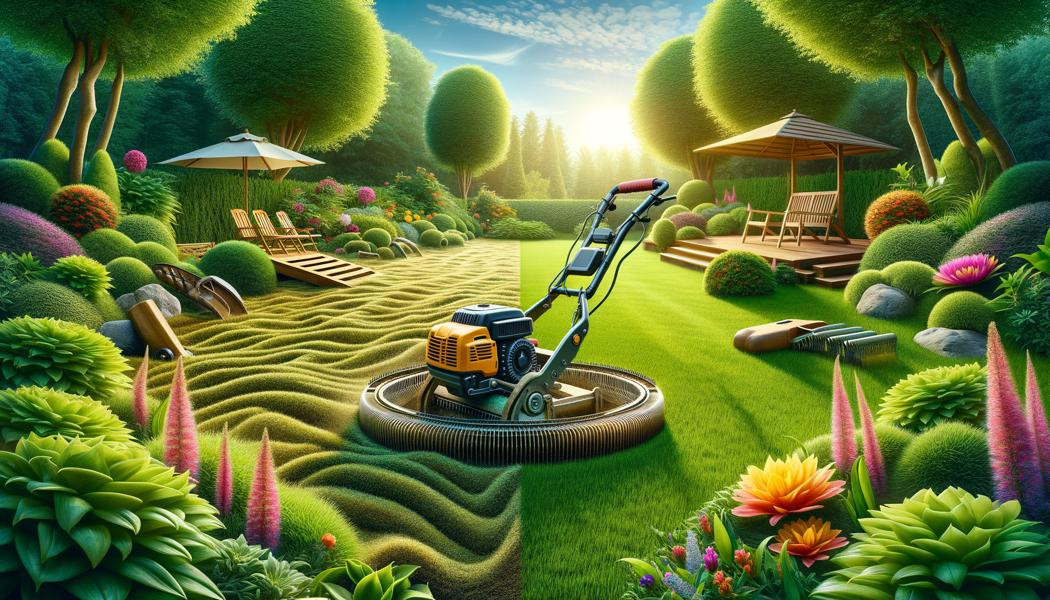
In this article, we will explore the importance of lawn scarification as well as the different tools available to achieve optimal results. Scarification is a crucial operation that helps maintain a healthy lawn by removing debris and promoting the circulation of air, water, and nutrients. We will also discuss the criteria for choosing the right tools, how to use them efficiently, and complementary techniques to improve the health of your lawn.
Do you need help scarifying your lawn? Quickly find a qualified provider on Helplease and benefit from a tailored service to meet all your needs. Discover professionals near you!Contents
- Why is it important to scarify your lawn?
- What are the signs that indicate scarification is necessary?
- What are the different types of tools for scarifying a lawn?
- How do you choose the right scarification tool based on the type of lawn?
- What criteria should you take into account when selecting an electric or manual scarifier?
- How do you use a scarifier efficiently for optimal results?
- What is the best time to scarify your lawn?
- What are the advantages and disadvantages of petrol-powered scarifiers?
- How to maintain your scarifier to ensure its durability?
- What mistakes should be avoided when scarifying the lawn?
- How to evaluate the results of a successful scarification?
- What other techniques can complement scarification for a healthy lawn?
Why is it important to scarify your lawn?
Scarifying the lawn plays an essential role in maintaining a healthy and attractive lawn. This practice removes moss, thatch, and other organic debris that can hinder the growth of grass. By making the soil more accessible to air, water, and nutrients, scarification promotes better root health and optimal growth of the lawn.
Additionally, scarifying helps prevent the emergence of fungal diseases. By regulating and evacuating decomposing organic material, it reduces excessive humidity that can encourage infections. A well-scarified lawn is also less likely to be invaded by weeds, as it provides less favorable ground for their development.
Finally, scarification helps strengthen the lawn’s resilience to environmental stress such as drought or temperature fluctuations. By promoting soil aeration, plant roots are better anchored, improving their ability to survive in adverse conditions.
In short, scarifying your lawn is a tactical essential step to ensure a lawn that is not only beautiful, but also robust and long-lasting.
Professionals, looking for more clients? Sign up on Helplease today to offer your services and grow your business. Access a large client base in just a few clicks!What are the signs that indicate scarification is necessary?
Identifying the signs that scarification is needed can seem complicated, but some indicators are easy to recognize. First, the presence of moss and thatch is a clear signal that the lawn needs scarifying. If the surface becomes spongy, it means it has accumulated too much organic debris.
Another factor is root adherence. If your lawn seems to have drainage issues, thatch build-up may be to blame. This prevents water and nutrients from properly penetrating the soil, making the lawn more vulnerable.
Finally, a lawn that does not grow back effectively after mowing may also indicate that it needs scarifying. Poor growth can result from compacted soil and an underdeveloped root network, both of which need to be aerated by scarification.
Monitoring these signs will help you determine the right time to perform scarification and keep your lawn in its best condition.
If you are looking for an expert to meet your specific needs, visit Helplease and discover available service providers near you. Make your life easier and find the right professional!What are the different types of tools for scarifying a lawn?
There are several types of tools for scarifying the lawn, each with its own characteristics and advantages. Manual scarifiers, for example, are ideal for small areas. These tools, generally equipped with steel blades, remove thatch by a back-and-forth movement. They are lightweight and encourage an eco-friendly approach.
Electric scarifiers, on the other hand, are better suited for larger spaces. Equipped with scraping blades, they offer increased efficiency. These models allow you to complete the work more quickly while reducing the required physical effort. They are often height-adjustable to adapt to different types of lawn.
Lastly, petrol-powered scarifiers are designed for large areas. These models offer great power and can handle heavily grassed lawns. They are often equipped with advanced features such as adjustable scarification depth, allowing for customization according to the specific needs of your land.
With these different tools, it is crucial to choose the one that best suits the size of your lawn and your budget to guarantee optimal results.
How do you choose the right scarification tool based on the type of lawn?
Choosing the right tool to scarify your lawn requires understanding the nature of your grass. If you have a fine lawn, such as a meadow lawn, a light manual or electric scarifier may suffice. These tools work gently, preserving the texture and integrity of the blades of grass while removing excess organic matter.
For denser or rougher types of lawn, such as a sports turf, a petrol-powered scarifier is often more appropriate. Its power allows it to penetrate deeper into the soil and efficiently remove excess thatch. This helps achieve a well-aerated and healthy lawn.
Moreover, the frequency of maintenance also plays a role in the tool choice. If you scarify your lawn often, investing in an electric or petrol model might be cost-effective in the long run. These tools can withstand regular use without much fatigue.
In summary, analyzing the type of lawn and envisaged use will help you choose the most suitable scarifier, thus optimizing your gardening task.
What criteria should you take into account when selecting an electric or manual scarifier?
When choosing between an electric or manual scarifier, several criteria must be considered. The first is the size of your lawn. If your garden is small, a manual scarifier might suffice and be economical. It also allows for precise control and requires less maintenance.
On the other hand, for large areas or thick lawns, an electric scarifier is more suitable. It allows quick work with little effort, which is essential if the area to be scarified is extensive. Also, check the power of the device: a more powerful engine will be able to handle more challenging lawns.
Another aspect to consider is noise. Manual scarifiers are much quieter, while electric models generate noise that can disturb neighbors, especially in residential areas. Also think about ease of storage, particularly for a tool you only use once or twice a year.
Finally, evaluate your budget. Manual scarifiers are generally cheaper, while electric and petrol models are more expensive but offer increased performance. Finding a balance between budget and performance will help you choose the right tool.
How do you use a scarifier efficiently for optimal results?
To ensure optimal results when using a scarifier, it is important to follow several key steps. First, prepare your lawn. Mow it at a suitable height and remove all objects such as stones, branches, or toys that might damage the tool.
Next, adjust the scarification depth. A depth of 3 mm is often recommended to start, as it aerates without damaging the lawn. If your lawn is very matted, feel free to increase the depth slightly during later passes.
Use the tool in segments, following movement patterns that ensure every section is well scarified. It is advisable to go in one direction, then pass perpendicular for uniform coverage. Finally, after scarification, water your lawn to help with regeneration and spread a suitable fertilizer to stimulate growth.
These steps will maximize the efficiency of your scarifier and help restore the health of your lawn.
What is the best time to scarify your lawn?
The ideal time for scarifying often depends on the type of lawn you have. In general, the best seasons for scarification are spring and autumn. In spring, as it begins to warm up, the lawn is ready to grow after winter. This is the perfect time to remove thatch and allow new shoots to grow healthily.
In autumn, it is time to prepare the lawn for winter. Scarifying at this time helps remove accumulated moss and aerate the soil, allowing it to better absorb water and nutrients before the winter rest. Avoid scarifying during periods of extreme heat or drought, as this could stress the lawn.
Finally, monitor the weather: prioritize days when rain is expected after scarification. This promotes regeneration, as the water will help hydrate exposed roots.
Knowing these key periods will enable you to keep your lawn in excellent condition all year round.
What are the advantages and disadvantages of petrol-powered scarifiers?
Petrol-powered scarifiers offer several advantages, but they are not without some disadvantages. One of the main advantages is their power. These models are ideal for large areas and for scarifying very grassy lawns, as they can run continuously and handle heavy loads.
Another advantage is their efficiency. Petrol-powered scarifiers can often handle more compact soil and offer flexible settings, allowing you to adapt to the specific needs of your lawn. Moreover, their range is generally greater, reducing the time spent scarifying.
However, they also have drawbacks. Their weight can make them difficult to maneuver, especially on sloping ground. In addition, they require more frequent maintenance, such as checking the oil level and cleaning the air filter. Lastly, the noise generated by these machines can be bothersome, particularly in urban or residential areas, and their emissions also have an environmental impact.
By weighing these advantages and disadvantages, you can decide if a petrol-powered scarifier is right for your needs.
How to maintain your scarifier to ensure its durability?
To ensure your scarifier’s durability, regular maintenance is crucial. Start by thoroughly cleaning the device after each use. Remove all debris and grass stuck to the blades. The accumulation of material can damage the engine and impair machine performance.
Next, check the blades periodically. They must be sharp to ensure efficient scarification. If they are dull or damaged, it is advisable to replace them. Also, audit the engine: check oil levels and the air filter, cleaning or replacing them if needed to ensure optimal operation.
Finally, store your scarifier in a dry place, safe from bad weather. Humidity can cause rust and other potential damage. Taking care of your tool will help extend its lifespan and maintain its effectiveness for years to come.
What mistakes should be avoided when scarifying the lawn?
During scarification, some common mistakes can compromise the results. One of the main errors is scarifying soil that is too wet or too dry. This can damage the roots and harm the health of the lawn. It is therefore essential to choose the right moment, as mentioned previously.
Another common mistake is neglecting to pick up debris after scarification. If waste remains on the lawn, it can hinder hydration and the intake of essential nutrients by blocking root access to air and water.
Avoid scarifying too deeply, as this can harm the roots. Start with a moderate depth and adjust it according to your lawn’s specific needs. Finally, do not think that one scarification per year is enough. Regular maintenance ensures a well-kept lawn and prevents thatch build-up.
By avoiding these mistakes, you will help keep your lawn healthy and beautiful in the best possible way.
How to evaluate the results of a successful scarification?
After scarification, several indicators make it possible to assess success. First, observe the lawn’s texture. A greener, denser, and more uniform appearance indicates that scarification has improved the circulation of air and nutrients. New shoots should appear quickly if scarification has been effective.
Next, analyze the soil’s reactivity. A properly scarified lawn drains better, and extra water should penetrate quickly into the soil instead of stagnating on the surface. This shows that the thatch has been effectively reduced, allowing better absorption.
It is also good to note the decrease in moss a few weeks after scarification. If moss is still present, this may mean that scarification needs to be repeated, or that there is an underlying problem to address.
Finally, good post-scarification care, such as regular watering and the addition of fertilizers, helps assess success by encouraging your lawn’s rapid regeneration.
What other techniques can complement scarification for a healthy lawn?
Scarification can be optimized by combining other maintenance techniques. Aeration, for example, is an effective method to improve air circulation, especially on compacted grounds. Using a spike or hollow tine aerator opens the soil deeply, helping to keep a healthy lawn.
The application of a good fertilizer is also recommended after scarification. A suitable fertilizer will help nourish the roots and encourage the growth of a dense and green lawn, filling the gaps left after scarification.
Finally, do not forget the importance of a wise watering approach. After scarification, it is essential to water lightly to not only hydrate, but also facilitate settling of the loosened soil and promote regeneration.
Each complementary technique helps maintain a robust lawn and adds to the effectiveness of scarification. By integrating these methods, your lawn will be visibly healthier and more vibrant.
Conclusion
In summary, scarifying the lawn is a fundamental operation to ensure the health and beauty of your garden. By taking the time to evaluate the signs of necessity, choosing the right tool, and applying the right techniques, you can maximize the benefits of this practice. Whether using a manual, electric or petrol scarifier, the essential is to understand your lawn and tailor your work to its specific needs. Remember to combine scarification with other techniques, such as aeration and fertilizing, for optimal results. With proper maintenance and the right practices, your lawn will display its full splendor season after season.
Whether you need quick help or want to offer your services, Helplease is your solution! Download the app to connect with qualified experts or find clients in one click, and make your everyday life easier! Available on iOS and Android!